Viscosity Solutions on Ramified Spaces
Develops a consistent viscosity solution theory for Hamilton–Jacobi equations on ramified spaces (networks, LEP-spaces) – with correct transition conditions, comparison principle, and consistency with vanishing viscosity. Doctoral thesis, 2006.
In the blog: How a Tübingen Doctoral Thesis Helped Found an Entire Research Field
Read blog postDoctoral Thesis
Download PDFExplainer Video (NotebookLM)
Podcast Summary (NotebookLM)
Summary (NotebookLM)
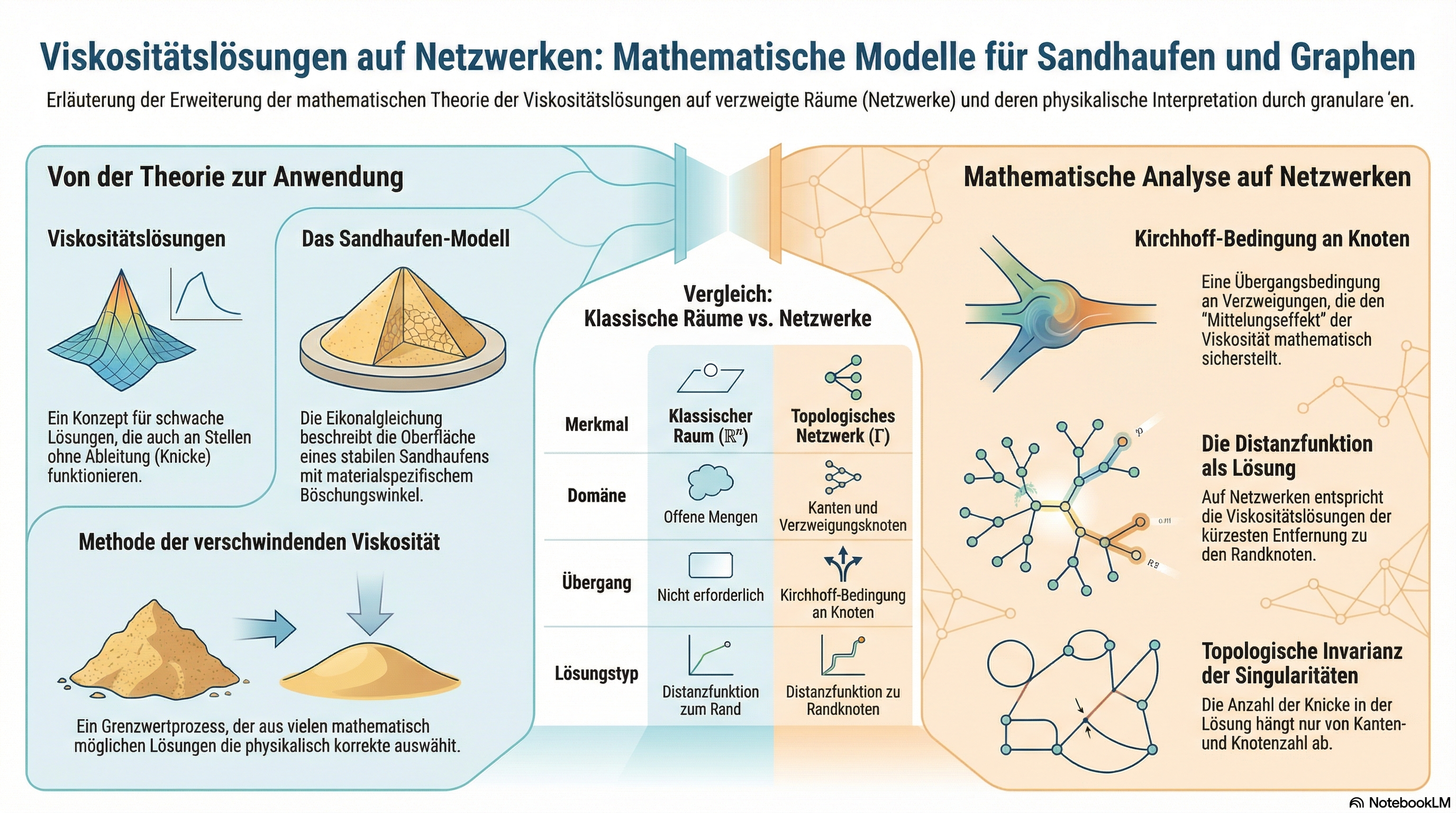
Open in new tab →The thesis develops a viscosity solution theory for Hamilton–Jacobi equations on ramified spaces, particularly networks and graphs, and connects this with vanishing viscosity and the distance function.
Motivation & Goal
In many applications (e.g. interactions between different “branches”/media), PDEs are not defined on smooth manifolds but on spaces composed of several “branches” joined at transition points. For fully nonlinear equations (especially Hamilton–Jacobi), a rigorous viscosity solution theory for such settings was lacking.
Chapters 2–3: Foundations & Eikonal
Historical and conceptual background (Kruzhkov, Crandall–Lions) and a detailed analysis of the vanishing viscosity method applied to the eikonal problem. It is shown that on classical domains this method converges to the distance function to the boundary.
Chapter 4: Vanishing Viscosity on Networks
Extension to networks: for the second-order viscous regularization, one additionally requires a Kirchhoff condition (flux/derivative balance) at transition nodes in order to obtain uniqueness. Building on this, convergence results for the vanishing viscosity method on networks are derived.
Chapter 5: Viscosity Solutions on Networks (Main Contribution)
An intrinsic test-function-based definition of viscosity sub- and supersolutions on networks is formulated, including correct transition conditions at branching nodes. The key insight is: the limit obtained via vanishing viscosity does not satisfy the Kirchhoff condition, but rather a “pairwise” transition logic (evaluated over two incident edges at a time) – and this yields the comparison principle, uniqueness, and existence.
Chapter 6: Distance Function & Topology
Investigation of the distance function on networks: a “curvature functional” (counting suitably weighted local maxima/singularities of the distance function) is linked to a purely graph-theoretic/topological quantity of the network (including in the context of its cycle structure).
Chapter 7: Higher-Dimensional Ramified Spaces / LEP-Spaces
Introduction of ramified manifolds and the class of LEP-spaces (locally elementary polygonal ramified spaces), and extension of the network theory to these spaces. A complete existence theory for viscous regularizations is difficult in this geometry; however, convergence is shown provided a viscous approximation family exists.
Summary
The thesis provides a consistent framework for treating Hamilton–Jacobi equations on ramified spaces via viscosity solutions – including correct transition conditions, existence and uniqueness via the comparison principle, and consistency with vanishing viscosity. In addition, the distance function is characterized topologically as a structure-determining object.