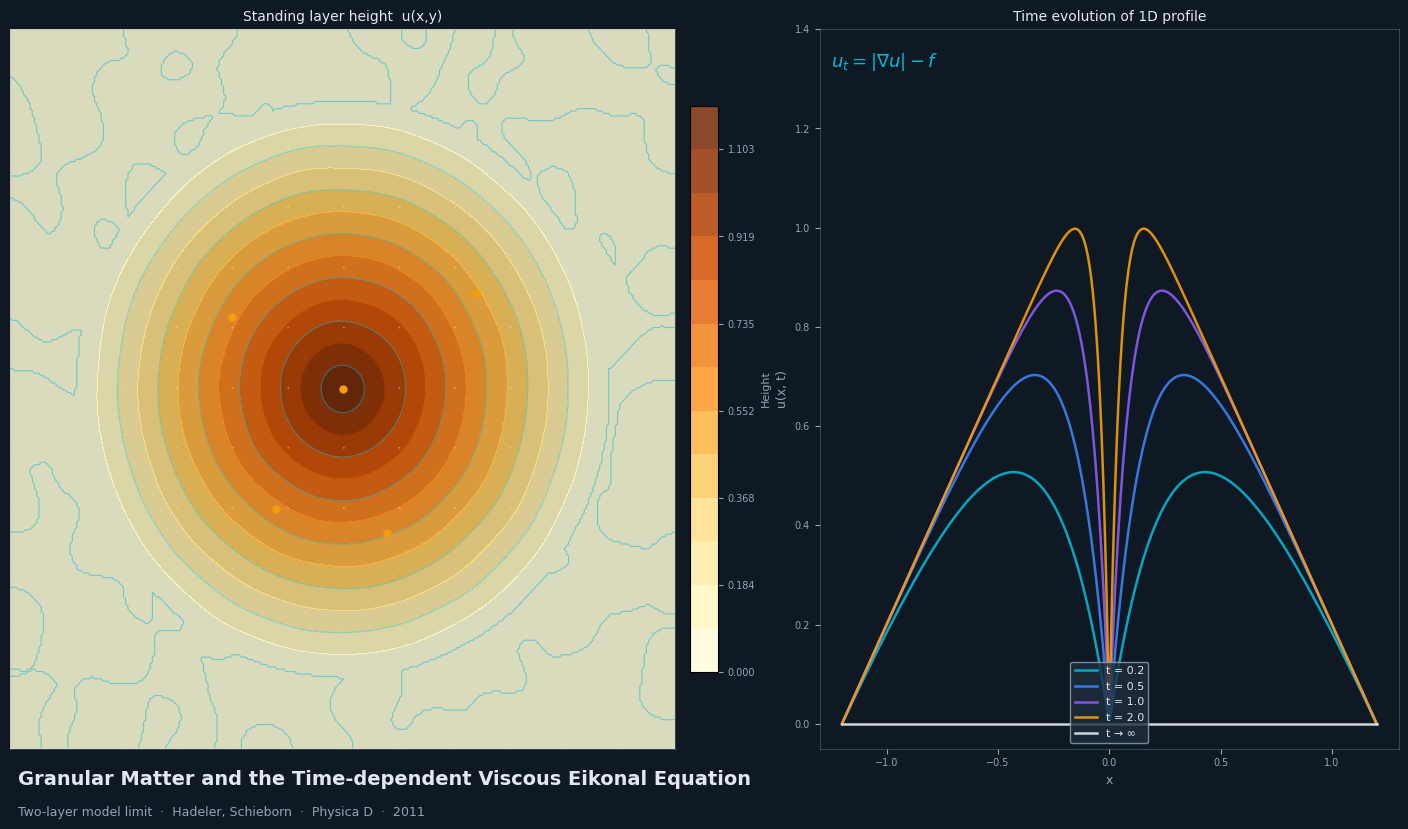
Granular Matter and the Time-dependent Viscous Eikonal Equation
Derivation of a time-dependent viscous eikonal equation as a limiting case of the two-layer model for granular matter. With Karl-Peter Hadeler, 2011.
Authors: Karl-Peter Hadeler, Dirk Schieborn
Journal: Physica D: Nonlinear Phenomena
Reference: PHYSD31154 · DOI 10.1016/j.physd.2011.11.018
Year of publication: 2011
Abstract
The deposition of granular matter under the influence of gravity can be described by the well-known two-layer model with a standing layer and a rolling layer. Material from sources enters the rolling layer, which flows along the gradient of the standing layer and eventually transitions into the standing layer through the interaction of both layers. From this system of two coupled hyperbolic partial differential equations, a time-dependent viscous eikonal equation is derived as a limiting case for weak sources, a thin rolling layer, and fast convection of the rolling layer. This equation, equipped with boundary conditions, describes the deposition of dry sand from uniformly distributed sources onto a flat table with a boundary of variable height. The stationary problem can also be understood as an application of the vanishing viscosity method to the eikonal equation. For certain types of interaction between the two layers, the resulting eikonal equation can be transformed into a linear equation. This transformation provides additional insights into the problem.