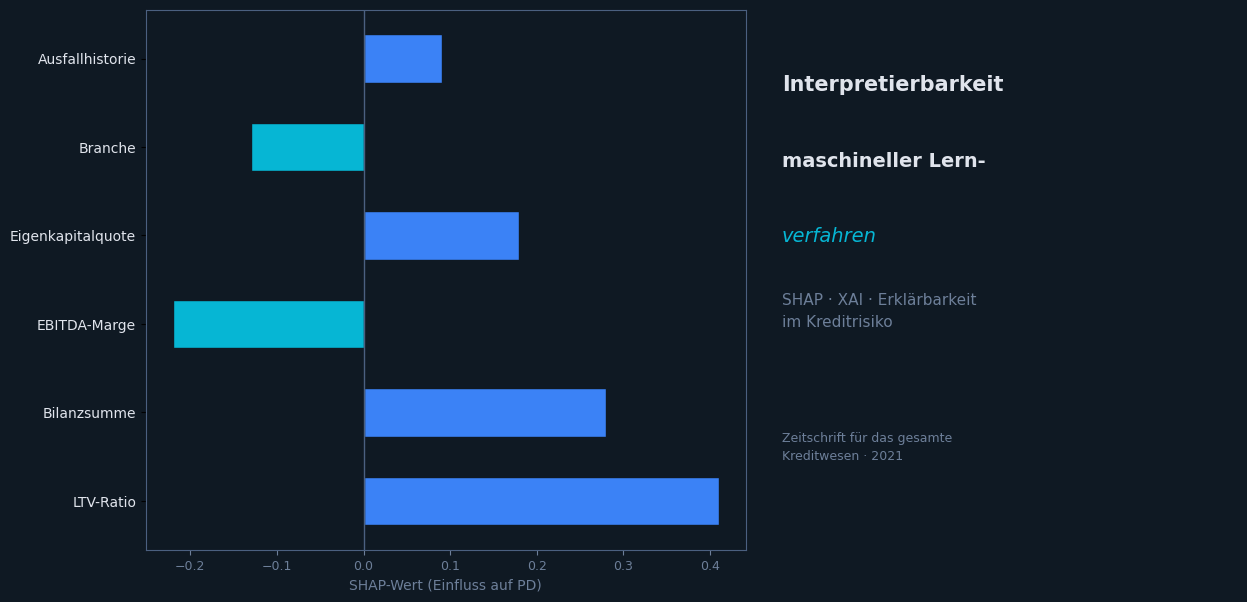
Interpretability of Machine Learning Methods in Credit Risk Measurement
Methods for explainability of ML models in the regulatory context of credit risk measurement – from SHAP to XAI frameworks.
Authors: Prof. Dr. Dirk Schieborn, Prof. Dr. Volker Reichenberger
Journal: Zeitschrift für das gesamte Kreditwesen
Year of publication: 2021
Abstract
Machine learning methods often deliver better predictive accuracy in credit risk measurement than classical statistical models – but their internal workings are harder to comprehend. This presents banks with a fundamental challenge: supervisory authorities expect rating systems to be explainable and validatable.
The article systematises the common approaches to interpretability (Explainable AI / XAI) and evaluates them with regard to their practical applicability for IRBA rating systems. The focus is on:
- Model-based interpretability: Decision trees, linear models with regularisation
- Post-hoc explainability: SHAP (SHapley Additive exPlanations), LIME
- Regulatory requirements: EBA guidelines, MaRisk, CRR documentation obligations
Conclusion
A carefully chosen combination of high-performing ML methods and suitable explainability techniques enables banks to harness the potential of artificial intelligence in risk management – without compromising regulatory requirements.